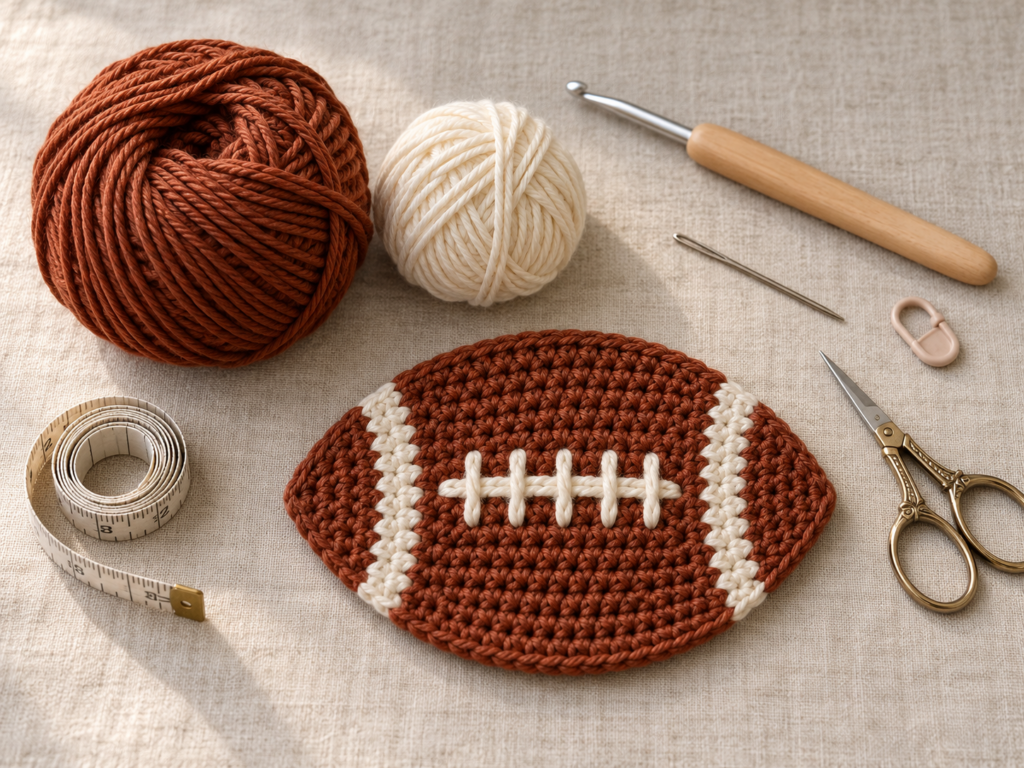
A football coaster is one of those small crochet projects that gives you a finished result before you have time to become bored with it. You need only a small amount of yarn, the shape is easy to recognize, and the white laces make even a very simple crochet fabric look unmistakably football-themed.
This beginner-friendly crochet football coaster pattern is worked flat in rows instead of starting with a complicated motif. You will begin at one narrow end, gradually increase until the coaster reaches its widest point, crochet several straight rows through the center, then repeat the shaping in reverse with decreases.
After that, a simple single crochet edging cleans up the perimeter and cream yarn is embroidered across the center to create the football seam and laces.
The finished coaster should measure roughly 5½–6 inches long and 3½–4 inches wide, depending on your yarn, hook and personal tension.
What You’ll Learn
- How to shape crochet fabric using increases
- How to work even rows without accidentally changing the stitch count
- How to make a basic hdc2tog decrease
- How to create two matching tapered ends
- How to add a neat single crochet border
- How to embroider simple football laces
- How to resize the coaster for different cups or decorative uses
Materials You’ll Need
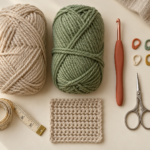
- Medium #4 cotton or cotton-blend yarn in rust brown
- Small amount of medium #4 yarn in cream or ivory
- 4.5 mm crochet hook
- Yarn or tapestry needle
- Scissors
- Optional stitch markers
- Measuring tape
Cotton is particularly useful for coasters because it makes a relatively firm fabric. Medium #4 is the standard medium/worsted yarn category; yarn-weight categories are standardized by the Craft Yarn Council, although recommended hook ranges remain guidelines rather than absolute rules.
Crochet Abbreviations Used
This tutorial uses US crochet terminology.
- ch = chain
- hdc = half double crochet
- hdc2tog = half double crochet two together
- sc = single crochet
- sl st = slip stitch
- st/sts = stitch/stitches
- RS = right side
- WS = wrong side
- rep = repeat
These abbreviations follow standard crochet terminology used by the Craft Yarn Council.
For UK readers, a US half double crochet is called a half treble crochet, and US single crochet is UK double crochet.
Before You Start
Gauge and tension
Exact gauge is not critical for a coaster. What matters most is producing fabric that is:
- dense enough to protect a tabletop,
- flexible enough to lie flat,
- and not so stiff that the edges curl upward.
If your stitches feel unusually tight, change from a 4.5 mm to a 5.0 mm hook.
Count every row
This pattern depends on symmetrical shaping.
Your stitch counts progress:
2 → 4 → 6 → 8 → 10
Then remain at 10 stitches through the middle.
The second half reverses:
10 → 8 → 6 → 4 → 2
A stitch marker in the first and last stitch can help beginners recognize their row edges.
Turning chain
The ch 1 at the beginning of a row does not count as a stitch in this tutorial.
Your first real hdc therefore goes into the first stitch of the previous row.
Avoiding curling
A small amount of curling during the first few rows is normal.
Strong curling usually means:
- your starting chain is too tight,
- your hook is too small,
- or your edge stitches are significantly tighter than your center stitches.
Do not pull the working yarn tightly after completing the final stitch of each row.
Choosing colors
Traditional football colors are easy:
- rust or chocolate brown body
- cream or white laces
You can also use team-inspired colors. Avoid making every element the same color—the contrasting laces are what immediately communicate the football design.
Step-by-Step Crochet Tutorial
Step 1: Make the First Point
With brown yarn:
Ch 2.
Row 1
Work 2 hdc into the second chain from the hook.
Stitch count: 2
Ch 1 and turn.
This tiny row becomes the first tapered end of the football.
Beginner tip
The first row can be awkward because there is very little fabric to hold. Pinch the chain between your thumb and middle finger while making the two hdc.
Common mistake to avoid
Do not crochet into the chain directly beneath the loop on your hook. The second chain from the hook is your working chain.
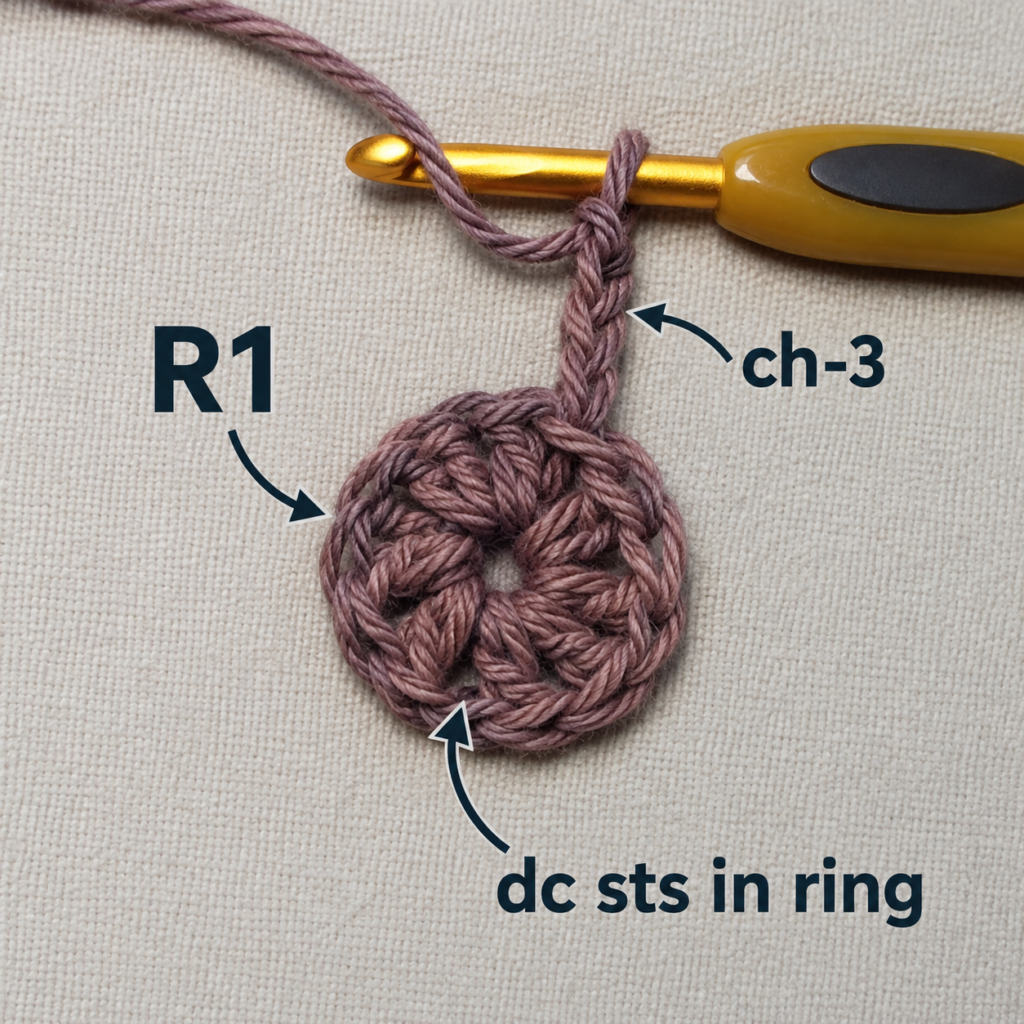
Step 2: Increase the First End
You will now add two stitches per row.
Row 2
Work 2 hdc in the first stitch and 2 hdc in the second stitch.
Stitch count: 4
Ch 1, turn.
Row 3
Work:
- 2 hdc in first stitch
- 1 hdc in each of next 2 stitches
- 2 hdc in final stitch
Stitch count: 6
Ch 1, turn.
Row 4
Work:
- 2 hdc in first stitch
- 1 hdc in each of next 4 stitches
- 2 hdc in final stitch
Stitch count: 8
Ch 1, turn.
Row 5
Work:
- 2 hdc in first stitch
- 1 hdc in each of next 6 stitches
- 2 hdc in final stitch
Stitch count: 10
You have now reached the maximum width.
Beginner tip
After every increase row, physically count the V-shaped stitch tops.
If your count is wrong here, the two sides of the finished football will not match.
Common mistake to avoid
Do not place both increases at the same edge. One increase belongs in the first stitch and one in the last stitch.
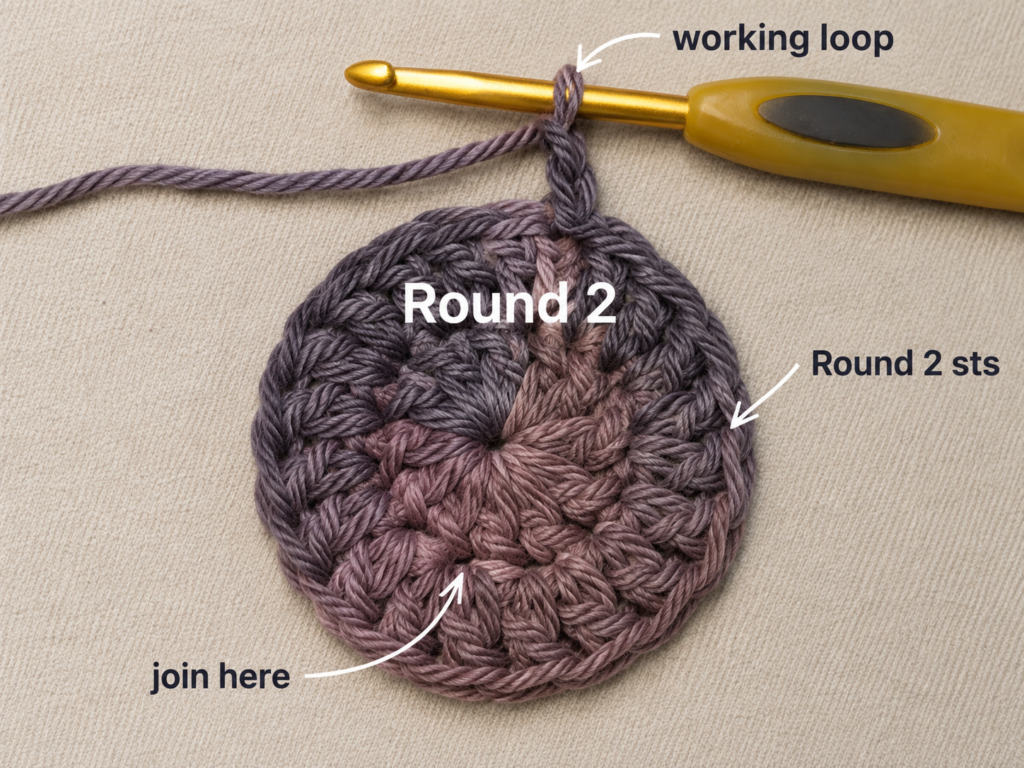
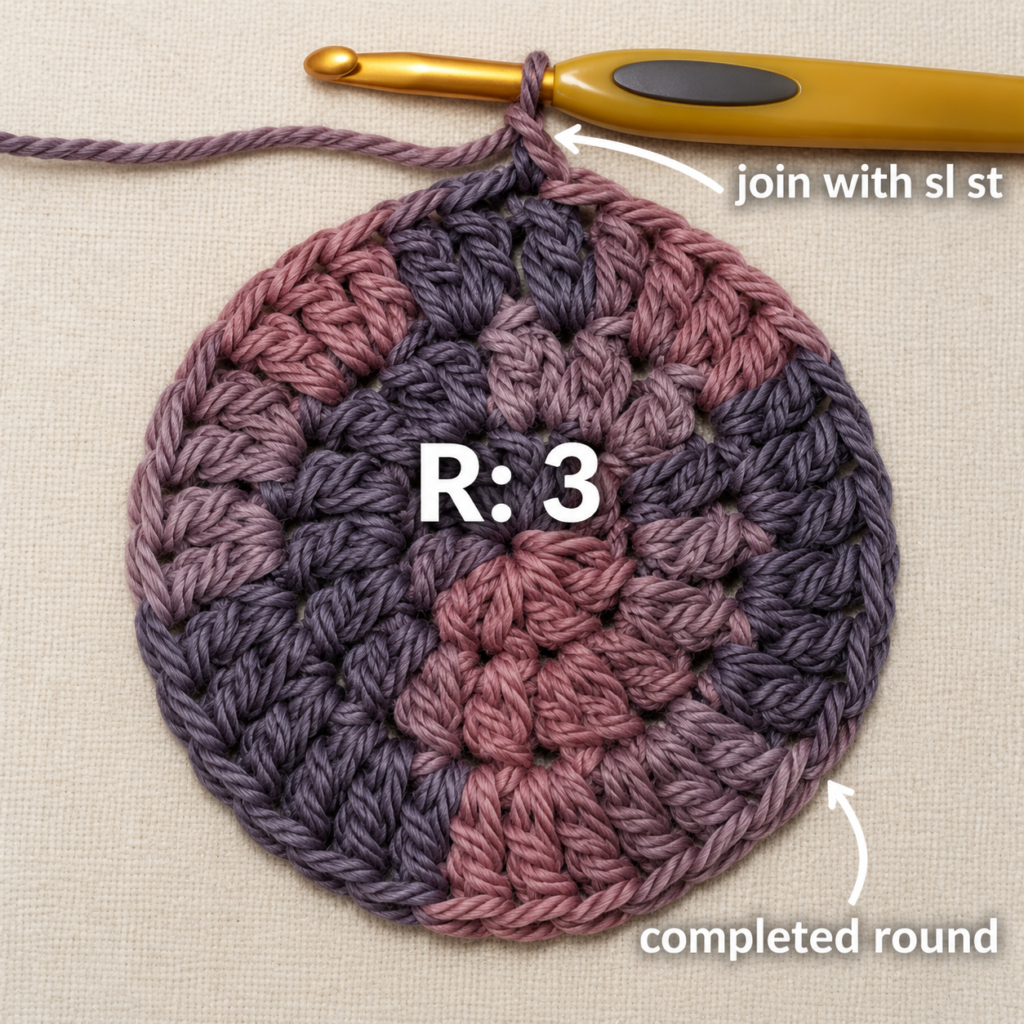
Step 3: Crochet the Straight Center
Rows 6–10
Ch 1 and turn at the beginning of each row.
Work 1 hdc in every stitch across.
10 stitches per row.
Repeat until you have completed Row 10.
These straight rows form the widest center section of the football.
Beginner tip
Count the first straight row carefully. If you accidentally skip the final stitch, the project will begin narrowing before you intend it to.
Common mistake to avoid
Your turning chain is not a stitch. Work your first hdc into the actual first stitch.
At this point the fabric should look something like a wide paddle: tapered at one end and straight through the newest rows.
Step 4: Decrease the Second End
Now reverse the shaping.
How to hdc2tog
Yarn over.
Insert your hook into the next stitch and pull up a loop.
You should have three loops on your hook.
Yarn over again, insert into the following stitch and pull up another loop.
Yarn over and draw through all loops.
Two stitches have become one.
Row 11
- hdc2tog
- hdc in next 6 sts
- hdc2tog
Stitch count: 8
Ch 1, turn.
Row 12
- hdc2tog
- hdc in next 4 sts
- hdc2tog
Stitch count: 6
Ch 1, turn.
Row 13
- hdc2tog
- hdc in next 2 sts
- hdc2tog
Stitch count: 4
Ch 1, turn.
Row 14
Work hdc2tog twice.
Stitch count: 2
Fasten off.
The football should now have two similar tapered ends.
Beginner tip
Lay your coaster flat after each decrease row. The second end should visually mirror the first.
Common mistake to avoid
Do not simply skip stitches at the ends to decrease. Skipped stitches create abrupt gaps. The hdc2tog creates a much smoother slope.
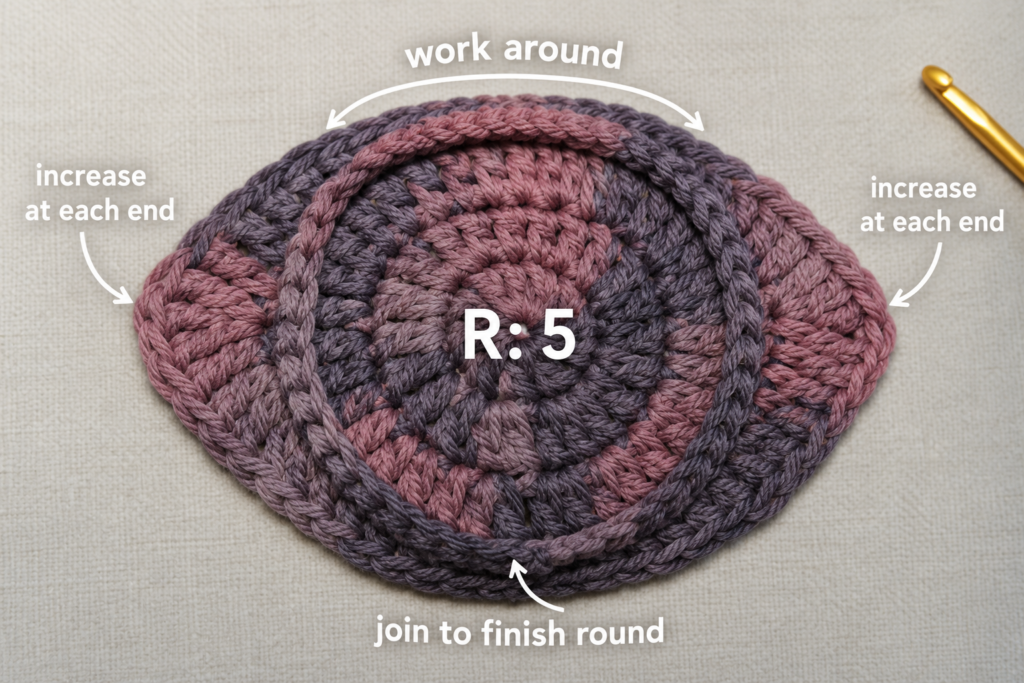
Step 5: Crochet a Neat Border
Rejoin brown yarn along one side.
Ch 1.
Work single crochet evenly around the perimeter.
Along the row edges, aim for roughly one sc per row end, adjusting slightly wherever necessary so the border lies flat.
At each narrow football tip, place approximately:
sc, ch 1, sc
into the end area.
This emphasizes the football point without creating an exaggerated corner.
Join to the first sc with a slip stitch.
Fasten off.
Beginner tip
Do not obsess over a specific total border stitch count. The important test is whether the coaster lies flat.
Common mistake to avoid
Too many stitches along an edge make it ripple.
Too few pull the coaster inward.
If the border starts waving dramatically, unravel that section and redistribute your stitches.
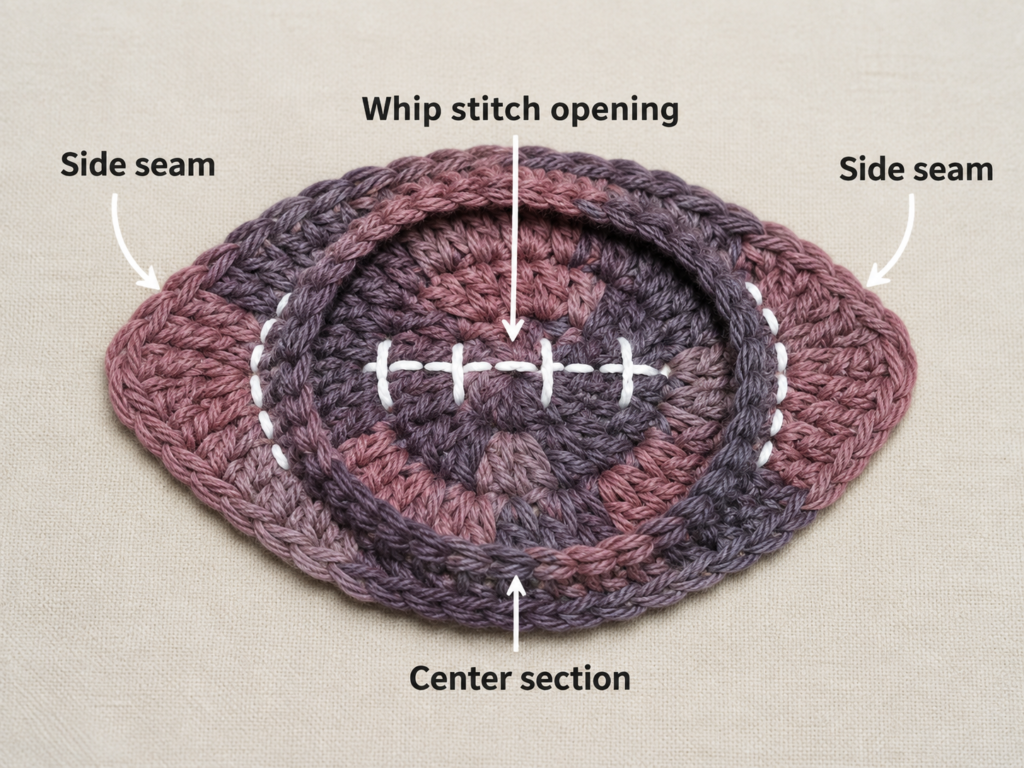
Step 6: Add the Football Laces
Thread approximately 18–24 inches of cream yarn onto a tapestry needle.
Choose the side of the coaster you like best as the right side.
Position the football horizontally.
First embroider one long straight line through the center.
Then create four or five short stitches perpendicular to the long line.
Keep the spacing even.
You do not need to pull the cream yarn tightly. The stitches should sit on top of the crochet fabric rather than sinking deeply into it.
Beginner tip
Before stitching, place four removable stitch markers where the cross-laces will go. This helps maintain equal spacing.
Common mistake to avoid
Do not pull embroidery stitches tightly enough to distort the coaster.
Step 7: Add Optional End Stripes
For a more detailed football design, use cream yarn to add a curved or slightly angled line approximately one inch inward from each tapered end.
Keep the stripe light rather than bulky.
The stripe can be:
- embroidered using backstitch,
- worked with surface slip stitches,
- or omitted entirely.
For a true beginner project, the center laces alone are enough.
Pattern Notes or Stitch Notes
Turning chain: Ch 1 does not count as a stitch.
Maximum stitch count: 10 hdc.
Increase rule: Add one stitch at both outer edges of each increase row.
Center section: Maintain 10 stitches.
Decrease rule: Join the first two and last two stitches with hdc2tog.
Right side/wrong side: Hdc produces attractive texture on both sides. Choose whichever side appears smoother for embroidery.
Size adjustment: Add or remove straight center rows to alter length.
To make the football wider, continue increasing beyond 10 stitches before beginning the straight section.
To make a mini football applique, use DK yarn and a smaller hook while keeping the same construction concept.
Common Beginner Mistakes
1. Losing the last stitch
The last stitch can hide beside the turning chain.
Fix: Count every row and place a stitch marker into the first stitch as soon as you make it.
2. Counting the turning chain
Doing this gradually adds an unwanted stitch.
Fix: Remember that the ch 1 is only for height.
3. Uneven football sides
This usually happens when one increase or decrease was missed.
Fix: Check your counts against the sequence:
2, 4, 6, 8, 10 → straight section → 8, 6, 4, 2.
4. Curled fabric
Very tight tension is the usual cause.
Fix: Relax your working yarn or move up half a hook size.
5. Wavy border
Too many sc stitches are being placed around the perimeter.
Fix: Remove several border stitches and redistribute them more evenly.
6. Embroidery puckering
The cream yarn has been pulled too tightly.
Fix: Leave each surface stitch relaxed enough to sit naturally over the crochet texture.
7. Uneven laces
The perpendicular stitches were added without planning.
Fix: Mark the positions before embroidering.
How to Customize This Crochet Project
Change the yarn
Cotton is my first choice for functional drink coasters, but acrylic works if you primarily want game-day decorations.
Check the fiber content and care instructions on the yarn label before washing. Yarn labels normally provide fiber, weight, gauge and care information.
Use team colors
Try:
- navy football + gold laces
- burgundy football + cream laces
- green football + white laces
- orange football + navy laces
You do not need official logos for the project to suggest a favorite team.
Change the size
For a longer coaster, simply add more 10-stitch center rows.
For a wider coaster, add another increase row before beginning the middle.
Remember to create a corresponding extra decrease row at the opposite end.
Add texture
Try working the center rows in:
- back loop only hdc,
- alternating sc and hdc,
- or a subtle ribbed stitch.
Avoid extremely raised bobbles because a drinking glass should have a stable surface.
Turn it into an applique
Skip the border or use a very thin border and sew the football onto:
- a blanket,
- a tote bag,
- a scarf,
- a pillow,
- or a sports-themed bunting.
Make game-day gifts
Create four or six matching coasters and tie them together with cream yarn.
They work particularly well as:
- host gifts,
- Father’s Day projects,
- football-party favors,
- coach gifts,
- sports-room decor.
Finishing Instructions
Weave each yarn tail through several nearby stitches on the wrong side.
Change direction once while weaving the tail so it is less likely to work free.
Trim the remaining yarn.
For cotton yarn, lightly dampen the coaster and shape it by hand.
Pinning is rarely necessary unless your points are uneven.
Allow the piece to dry completely before use.
Follow your yarn manufacturer’s washing instructions. For frequently used cotton coasters, gentle washing and reshaping while damp will usually restore the silhouette.
Acrylic coasters should not be treated as heat-resistant trivets. This pattern is intended for glasses, cups and mugs, not hot cookware.
Quick Printable-Style Summary
Skill level: Confident beginner
Finished size: Approximately 5½–6 × 3½–4 inches
Yarn: Medium #4 cotton or cotton blend
Hook: 4.5 mm
Main stitches: hdc, hdc2tog, sc, sl st
Starting method: Ch 2, work 2 hdc into second chain
Increase sequence: 2, 4, 6, 8, 10 stitches
Middle: Work even at 10 stitches
Decrease sequence: 8, 6, 4, 2 stitches
Border: Single crochet evenly around
Finishing: Embroider a center seam and 4–5 cream football laces, weave in ends and lightly block.
FAQ
Is a crochet football coaster suitable for beginners?
Yes. This version requires only chains, half double crochet, single crochet and one basic decrease. The most important skill is counting stitches accurately.
What yarn is best for crochet coasters?
Cotton or cotton blends are useful because they make firm crochet fabric and are practical around drinkware. Medium #4 yarn is easy for beginners to handle.
Can I use acrylic yarn?
Yes for decorative coasters, although cotton is generally my preference for drink coasters. Never assume acrylic is suitable for very hot cookware.
How large should a football coaster be?
Approximately 5½–6 inches long is convenient for most mugs and glasses while preserving the recognizable elongated football shape.
Why is my football coaster curling?
Your tension may be too tight. Try a slightly larger crochet hook and avoid tightening the yarn after every edge stitch.
How can I make the football longer?
Add additional rows while the coaster is at its maximum width of 10 stitches.
For example, instead of five straight center rows, work seven or eight.
Do I have to embroider the white end stripes?
No. The center seam and cross-laces are sufficient for the design to read clearly as a football.
Conclusion
This crochet football coaster pattern is small enough for an evening project but includes several useful skills that transfer directly to larger crochet work: symmetrical increases, straight-edge maintenance, decreasing, edging and simple surface embroidery.
Once you have made the first coaster, the stitch-count sequence becomes easy to remember. Work a set in classic brown and cream for game-day decor, or replace the colors with a favorite team’s palette.